Featured

Marketing Guru Blog

My Brand

My name is Curtis Young. I am 19-years-old. I attended Cavendish Road State High School for five years. My enjoyment of business has lead me to study at the University of Queensland where I am completing an Associate Degree in Business. I am currently unemployed, although I have previously been employed. I have a passion for business and a variety of skills that should allow the transition from university to employment go smoothly.

Valuable life experiences have allowed me to gain a variety of interpersonal skills throughout my life that could make my campaign for employment in a business world extremely successful. At my previous employment I learnt the importance of communication whether it be marketing a product to a consumer or working on a project within a team. The subjects within school have taught me the importance of planning and organisation.

I am excited to see what marketing will teach me and how I will be able to use it in the business world. I know the future will hold many opportunities.

Pricing Strategies for Creating Customer Value

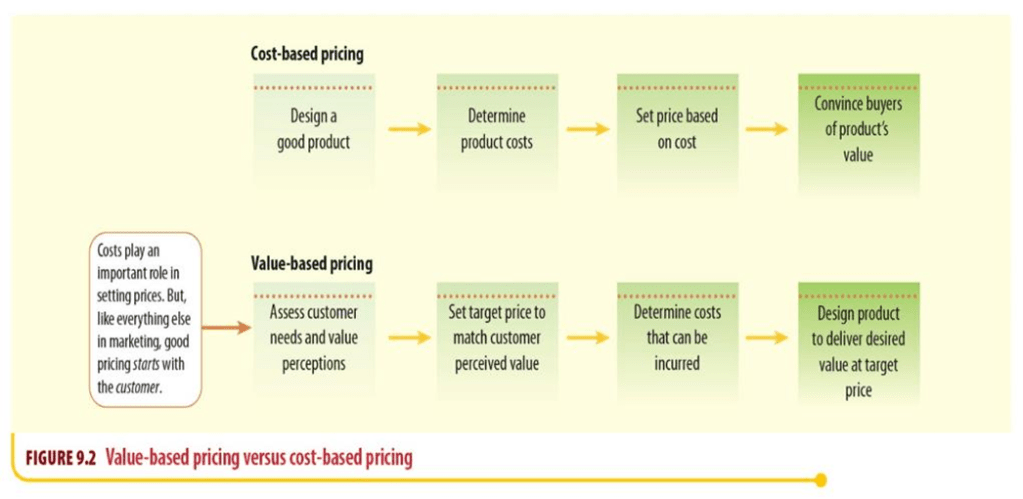
Customers that seek value put a lot of pressure upon companies to alter prices in order to get the most benefit out of the organisation’s good or service (Armstrong, Adam, Denize, Volkov, Kotler, 2019). In order for companies to create customer value they must find the right price. There are three main pricing strategies that organisations utilise to create customer value these include price setting, cost-based pricing and value-based pricing (Armstrong, Adam, Denize, Volkov, Kotler, 2019). In the price setting strategy there is a floor price that is set by the production costs and a ceiling price which is set by the various perceptions that consumers have on product value, companies must research an abundance of external and internal factors such as supply and demand to find the right price (Armstrong, Adam, Denize, Volkov, Kotler, 2019). Cost-based pricing and value-based pricing are step by step strategies that allow companies to garner an understanding on how to price their products, the diagram below details the various steps.

Major Pricing Strategies (Armstrong, Adam, Denize, Volkov, Kotler, 2019)

The strategy that I would recommend for the Red Cross to utilise would be the price setting strategy. The price setting strategy is the most accurate and therefore would be advantageous to the group’s marketing plan. In order for it to be successful, research on many internal and external factors must be conducted. To understand the price ceiling consumers would have to be questioned about how they value the Red Cross’ services.

References:  Armstrong, G. Adam, S. Denize, S. Volkov, M. Kotler, P. (2019). Principles of Marketing. Melbourne, Victoria. Pearson Australia.

Offering Customer Value – Intangibility and Differentiation

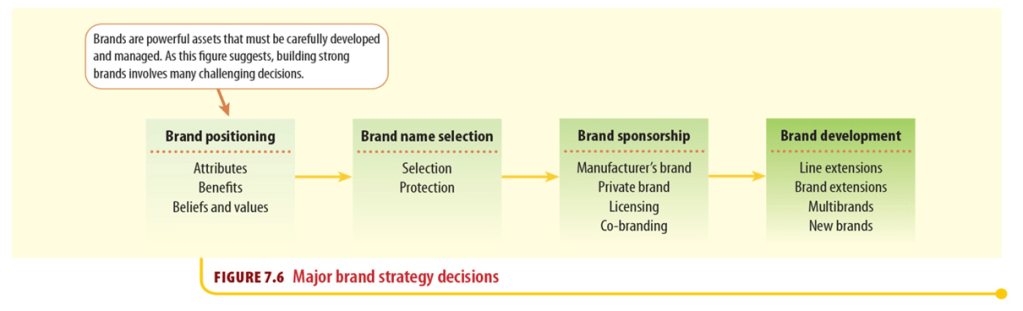
Products or goods are tangible things which entails they are items which can be measured or tasted. The intangibility of services means that service-providers heavily rely upon differentiation. Brands are extremely important assets and must be prepared and developed carefully and methodically(Armstrong, Adam, Denize, Volkov, Kotler, 2019). There are four major strategies in major brand decisions these include, brand positioning, brand name selection, brand sponsorship and brand development(Armstrong, et. al., 2019). Brand positioning involves the attributes, beliefs and values. Brand name selection involves selection and protection of the brand. Brand sponsorship involves licensing and co-branding. Brand development involves extending the brand to achieve more recognition (Armstrong, et. al., 2019).

Brand Decision Strategies (Armstrong, Adam, Denize, Volkov, Kotler, 2019).

Red Cross is one of many not for profit organisations around Brisbane so it is vital that they’re brand is unique and differentiated from its competitors. A key method to make the Red Cross unique and differentiate it from others is to hold fundraisers such as sausage sizzles or a marathon event. Red Cross has many blood bank outlets that help it differentiate itself from its competitors. The symbol behind Red Cross is a powerful one and will assist in alleviating itself from the competition. The online delivery services for Red Cross is another element that allows it to be more unique than other not for profit organisations in Brisbane.

References:  Armstrong, G. Adam, S. Denize, S. Volkov, M. Kotler, P. (2019). Principles of Marketing. Melbourne, Victoria. Pearson Australia.

Customer-Driven Marketing Strategy

It has recently become the norm for companies to focus and design their marketing strategies and plans towards a target market. A successful customer-driven marketing strategy must develop the right relationships with the right customers. The steps for the customer-driven marketing strategy include segmentation. differentiation, targeting and positioning. To ensure that an effective marketing strategy is designed and developed companies must understand how the market is segmented. The four key elements associated with segmentation of a market are geographic, demographic, psycho-graphic and behavioural(Armstrong, Adam, Denize, Volkov, Kotler, 2019).. Differentiation allows a higher form of customer value to be offered as it makes an organisation and its product unique(Armstrong, Adam, Denize, Volkov, Kotler, 2019). Targeting enables a company to select the segment that would be most advantageous to its cause. Positioning is key as it allows the company to situate itself within the minds of target customers (Armstrong, Adam, Denize, Volkov, Kotler, 2019).

Customer-Driven Strategy (Armstrong, Adam, Denize, Volkov, Kotler, 2019).

The group will implement a customer driven strategy to assist the Red Cross in creating value for targeted customers. The first step is arguably the most important as it allows the organisation to identify the various segments within the total market. By dividing the market into segments it will be easier to manage the different types of customers to serve. Differentiation will commence after segmentation, a method will be devised to make Red Cross unique. After analysis of the segments is complete the one that will aid in the Red Cross’ cause most will be targeted. Positioning will then occur allowing the Red Cross to create value for targeted customers.

References:  Armstrong, G. Adam, S. Denize, S. Volkov, M. Kotler, P. (2019). Principles of Marketing. Melbourne, Victoria. Pearson Australia.

Consumer and Business Buyer Behaviour

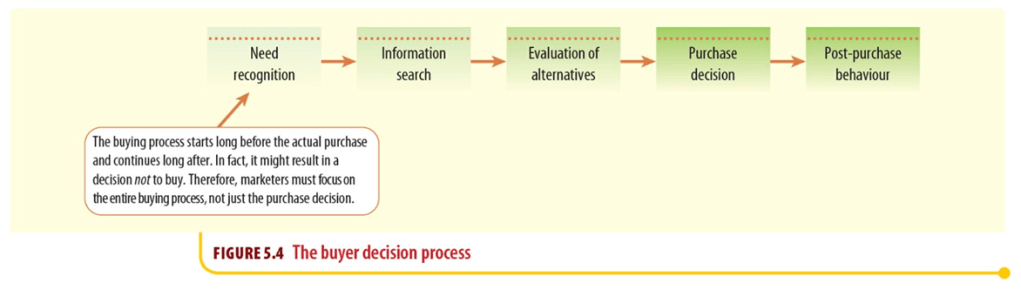
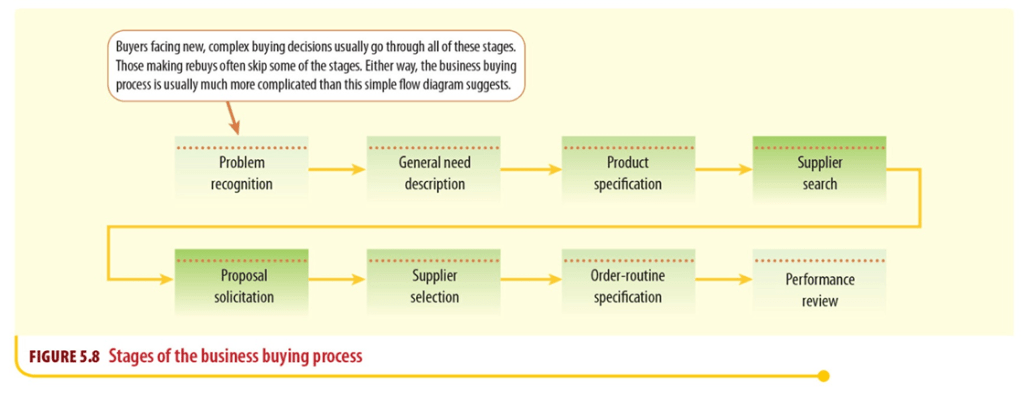
Commercial and personal information play a crucial role in educating consumers and businesses about a particular product. Neither consumers or businesses will be willing to purchase a product they have very little knowledge of. There are models associated with predicting the behaviours and attitudes of consumers and businesses. The consumer decision process model involves a series of steps that look at how consumers make decisions. The steps involved in the process include the need for recognition, information search, evaluation of alternatives, purchase decision and post purchase behaviour (Armstrong, Adam, Denize, Volkov, Kotler, 2019). The business buyer process model is more complex with more steps involved. The steps included within the model are as follows problem recognition, general need description, product specification, supplier search, proposal solicitation, supplier selection, order-routine specification and performance review (Armstrong, Adam, Denize, Volkov, Kotler, 2019).

Stages of consumer buyer process (Armstrong, Adam, Denize, Volkov, Kotler, 2019).
Stages of business buyer process. (Armstrong, Adam, Denize, Volkov, Kotler, 2019).

In the more recent times the most prevalent source of information associated with products would be the internet and social media sites. Social media is an appropriate outlet that many organisations use to promote and advertise goods and services. From Instagram to Facebook there are a multitude of sites that businesses can utilise to promote their goods and services. The marketing plan will encourage Red Cross to utilise social media as a source of information to influence consumers to get involved with their cause.

References: Armstrong, G. Adam, S. Denize, S. Volkov, M. Kotler, P. (2019). Principles of Marketing. Melbourne, Victoria. Pearson Australia.

Importance of Customer Insight

Customer insights are vital for not only gathering information and data but garnering an understanding of how to effectively market a good, service or organisation to the in a new market. Researching the market is extremely important as it enables companies to understand the tastes and preferences of consumers. There are three main types of research that must be conducted whilst entering into a new market these include exploratory research, descriptive research and casual research. There are an abundant reasons why organisations or businesses fail whilst entering a new market these include lack of research, lack of capital and lack of proper training.

The research plan for the Red Cross will involve engaging with the variety of sources associated with secondary data to garner a valuable insight on certain aspects associated with the foundation. This research will allow the group to gain the relevant secondary data. There are many potential problems in utilising secondary data. Time and date is a key one as the information and data may be unreliable and outdated entailing that it is no longer relevant. Accuracy is another key element if the data is inaccurate then it will have a drastic effect on the research, a method of remedying this would be to corroborate it with other secondary sources. Relevance is another potential problem because if the information isn’t relevant to the investigation the data will be inaccurate. Impartiality is the final potential problem assurances must be made that the source is credible, reliable and impartial, bias leads to unreliable information.

Marketing External Environments

Handling and maintaining external environments is crucial for an organisations success. There are a variety of environments that organisations such as the Red Cross must formulate strategies and operations to handle them. The environments include political-legal, economic, social-cultural, technological and ecological. Failure to adhere or adapt to the constantly changing trends.

The social-cultural environment can be handled by Red Cross by enhancing member engagement to increase the amount of volunteers. A method that would be efficient in persuading different demographics would be an effective marketing campaign. A prominent issue with the Red Cross is their reliance on the same people to continue generously donating however during certain times of the year Red Cross are unable to receive these donations. Setting up donation clinics at universities would be an excellent method of not only of receiving donations but to spread awareness to the younger generations in order to increase donations.

Image result for red cross volunteers

Red Cross

Red Cross is a not-for-profit organisation that was established in 1914 their main focus or purpose is to provide medical services and aid to vulnerable people across the globe. The key principles in which this charity was founded on and guided by include humanity impartiality, neutrality, independence, volunteer service, unity and universality. The main objective of this assignment is to establish an effective marketing plan that will lead to a profitable outcome for the Red Cross.

The Red Cross is a not-for-profit organisation this entails that its funding comes entirely from the donations of businesses and consumers. They heavily rely on aspects such as marketing and advertising campaigns to receive funding. It is imperative that the marketing campaign entices the main demographic to donate.

Our group will formulate and follow a simple yet effective method to effectively achieve this task. A SWOT analysis will be created to identify the key strengths and weaknesses associated with this particular organisation. Important environments and demographics must be analysed and evaluated to understand who this will be marketed towards. This will allow the basic structure and outline of the report to be formed

Image result for red cross image"
Design a site like this with WordPress.com
Get started